The positive sign I was waiting for ended up being right in front of me the entire time. Our entire team was blessed to have a strong group of sherpas assisting us. Shortly after I arrived back at Camp 2 a few of our sherpas started walking back in to camp singing and praying. Not only had they just gone to the summit the same day our team did, but they had the added responsibility of clearing the oxygen bottles and tents from the higher camps. The amount of weight they had on their back was staggering. Upon learning of Mike's condition several of them dropped their heavy loads, grabbed a couple of full oxygen bottles, and some hot tea and started climbing back up Everest again to reach Mike. In my book, these guys are the heros.
Several hours later, heavily assisted, Mike gingerly walks back in to Camp 2. I went over to greet him and I knew something was still wrong with him. He had a blank stare and would not talk. He was beginning to suffer from facial edema as well (swelling of the face in addition to swelling of the brain). I assisted with taking off his harness and other essential elements for ice climbing and we put him in our dining tent. A few of our teammates who had arrived with him began filtering in to the dining dome as well. Still suffering from the delierious effects of altitude, Mike began arguing and swearing. He would not eat or drink. I found this extremely strange. Especially since he had not eaten or had anything to drink for 2 days. I sat next to Mike and tried to see how I could help. I spoke softly with him and asked him what was going on. I never imagined what I was about to hear.
Mike looked in my eyes and spoke softly and yet with great conviction. He told me how he had joined our Everest team as a double agent for the British Secret Service. He confided in me that there was a huge illegal drug operation going on and the high mountain passes of Everest were the drug's pathway between China and Nepal. He was put on the team in order to bust the drug cartels and to free this part of the world of illegal drug trafficing. He told me the reason he would not take the oxygen up higher on the mountain was that the bottles, in fact, were not oxygen but argon gas. Everyone up higher on the mountain, wrapped in thick down suits and oxygen masks, were the enemy. This is what his paranoia induced brain was telling him. He would not take any oral dexamethasone pills because they were poison. He was absolutely 100% certain that everyone had found out his position in the B.S.S. and the Chinese had sent people to kill him.
Wow! Why was he telling me this and no one else? Why did he feel confident that I was not one of the bad guys? I thought back to the Bible verse, "The Lord works in mysterious ways". What a mystery this was and I was deep in the middle of it.
After several hours of Mike talking to me I decided to use his comfort and familiarity with me to his advantage. I gently persuaded him to drink some hot tea and to eat a few biscuits. Phil came in to the tent and told Mike he needed to take some more dexamethasone, orally. Immediately, Mike became irate and absolutely refused. "I may have been found out, but I will not be put to death. I will not be poisoned." You see, Phil had heroically helped Mike for most of the last 48 hours and was exhausted. He took great care and responsibility for his teammates but I could see in his eyes that this situation was wearing on him. Phil and I had gotten to know each other quite well, as this was our third Himalayan climb together. Phil and I locked eyes and I nodded my head. He immediately knew what I would do. I immediately knew what he would do. I told Phil, "I've got this". Secretly, outside of Mike's vision, Phil put the dexamethasone tablets in to my hand and left the tent. All alone in the tent, it was just Mike and I. I looked in to Mike's eyes and I told him, "Mike, this is the good stuff. I just brought this back with me over the border. This is not poison but pills to help with your fatigue. Trust me." Mike looked directly at me and paused. "I like your style" Mike said with complete trust. He grabbed the pills from my hand and swallowed them all - 6 in total. I persuaded him back to his tent and reassured him that the bottle I was giving him was my secret stash of real oxygen. I had successfully determined who was trying to give him argon gas earlier in the day and I had eliminated them from the situation.
Mike slipped in to a deep sleep and I was relieved-slightly. Taking the pills and oxygen had no doubt saved his life but he was now facing, head on, the most important night of his life. I prayed outside of his tent asking God to continue to use me to help save my friend's life. Utterly exhausted I crawled in to my tent. I thought I would fall asleep instantly but I could not. I was worried about Mike. Now that Mike was asleep, Phil had taken over monitoring him through the night. The objective was to do whatever it took to enable Mike to survive the bitterly cold, Himalayan night in great hope for a possible helicopter rescue the following morning. The growing storm outside the tent was suggesting otherwise. I prayed.
Thursday, October 14, 2010

Wednesday, September 29, 2010
The Summit Push (part 10)
I must confess that to my surprise Mike did make it through the night. I truly thought that I would hear word that Mike was unable to pull through. I was extremely happy to realize that our entire team was still intact.
I dozed restlessly though the night and found myself continually contemplating what I had just done. Wow! The previous day was so awesome and I hope that today would be equally as memorable. Today I was to begin my long descent back to Camp 2. Upon waking up I drank a little water and started packing. What a chore at 26,200'. I did not bother to eat because I wanted to get down. I peeked outside and the visibility was down to 10 meters. The wind was blowing and it was snowing. I felt bad for those trying for the summit today. I knew it was not possible and I hoped they had more time and strength to wait another day.
I quickly got ready and put on my pack and all of my climbing gear. I knew that I had to take it slowly and be very methodical about what I was doing. I took no more than 10 steps and I snagged my crampon on my Gore-Tex down suit. I immediately fell forward right onto my knees and hands. I looked around and quite a few people saw me fall. Worst of all Dave Hahn who was going for his 11th or 12th summit of Everest saw me fall. He is a climbing legend on Everest. Why did I have to fall in front of him? Why fall at all? Oh well. I stood up and began the traverse to the top of the Geneva Spur passing by the body of a fallen Sherpa climber from years ago. This sight, coupled with my recent fall was great motivation that I needed to be careful. Upon making the top of the Spur I tied into the rope and began my rappel. No problem because I took my time. A downward traverse and I was soon at the top of the Yellow Band. Another two rappels and I continued my very steep descent down the Lhotse Face. I was tired but gaining strength with every step down. I passed several people being assisted down by Sherpas, Guides, and anyone who could help. The past few days took a great toll on many people. There really was no place for me to join in the rescues so I continued down. I made it back to Camp 3 in several hours and I looked over at our tents which were now almost entirely buried by snow. I sure was happy to be going down and not have to sleep another night at Camp 3. The rest of the descent down the Lhotse Face went quickly and smoothly and I gained the top of the bergschrund. I anchored in and waited my turn to rappel over the gaping crevasse that lay 50 feet below me. What should have been a short wait was made much more complicated because I came upon a group of Sherpas who had no idea how to rappel. Hard to imagine but there were many people who did not know this basic form of rope craft. After what seemed to be an hour I finally made the rappel over the bergschrund and I took a huge sigh of relief. The most dangerous part of today was over. I now had to make the final downclimb to Camp 2. I was so thirsty and I was craving juice. I asked several people if they had anything extra to drink but no one helped me. Oh well. I started to pick up my pace. I was completely dehydrated and my appetite was coming back. I hadn't eaten a meal of any sort in 3 straight days. Just a few snacks is all that got me through. Eventually, I gained the rock that delineates the glacier edge from the rockfall of Camp 2. I slowed down and just took in the great views. This would be the last time I would see this place and I wanted to make sure to remember it.
I walked in to Camp 2 and I was greeted by our Camp 2 cook, Pasang Disco. He gave me a big hug and a cold glass of juice. Immediately he slipped away into the cook tent and began preparing a meal. In a few minutes he had a wonderful pasta dish created with fresh grated cheese. The meal was awesome (however a distant 2nd to my wife's cooking) and I enjoyed endless cups of juice. I realized that I was the first person back to our camp. I began to wonder about the rest of my team. I hoped they were safe. After several hours a few of my teammates began to trickle in. However, the one I was concerned about the most was nowhere to be found. Our communications radio crackled and chirped back to life and I could hear the familiar rambling of the Nepali tongue. Pasang Disco came out of the tent with a very concerned look. He turned around and faced the mountain gazing high up the Lhotse Face. I did not have to ask. I knew what was happening. Pasang Disco looked at me and said, "Mike - no good. Very bad up high." Crap. Why did this have to happen. As a climber descends in altitude he should get stronger. However, Mike was getting weaker and as it turned out he had completely relapsed. He had taken a turn far worse than yesterday and now a full scale rescue was in place. The steep, icy slopes of the Lhotse Face are not the easiest places to mount a rescue, but today there was no choice. We eventually made contact with the rescue group that was assisting Mike and we could hear their frustration. He was suffering from cerebral edema and was not thinking clearly. Worse than that he was very combative and would not take oxygen. What seemed like our only option was to call for a helicopter to try to rescue Mike. Unfortunately, a helicopter rescue from 24,000 feet was nearly impossible. As well, the helicopter was in Kathmandu and the weather was turning from bad to worse. I prayed for Mike's safety and just waited. I was waiting for some positive sign that Mike was going to make it down - alive.
I dozed restlessly though the night and found myself continually contemplating what I had just done. Wow! The previous day was so awesome and I hope that today would be equally as memorable. Today I was to begin my long descent back to Camp 2. Upon waking up I drank a little water and started packing. What a chore at 26,200'. I did not bother to eat because I wanted to get down. I peeked outside and the visibility was down to 10 meters. The wind was blowing and it was snowing. I felt bad for those trying for the summit today. I knew it was not possible and I hoped they had more time and strength to wait another day.
I quickly got ready and put on my pack and all of my climbing gear. I knew that I had to take it slowly and be very methodical about what I was doing. I took no more than 10 steps and I snagged my crampon on my Gore-Tex down suit. I immediately fell forward right onto my knees and hands. I looked around and quite a few people saw me fall. Worst of all Dave Hahn who was going for his 11th or 12th summit of Everest saw me fall. He is a climbing legend on Everest. Why did I have to fall in front of him? Why fall at all? Oh well. I stood up and began the traverse to the top of the Geneva Spur passing by the body of a fallen Sherpa climber from years ago. This sight, coupled with my recent fall was great motivation that I needed to be careful. Upon making the top of the Spur I tied into the rope and began my rappel. No problem because I took my time. A downward traverse and I was soon at the top of the Yellow Band. Another two rappels and I continued my very steep descent down the Lhotse Face. I was tired but gaining strength with every step down. I passed several people being assisted down by Sherpas, Guides, and anyone who could help. The past few days took a great toll on many people. There really was no place for me to join in the rescues so I continued down. I made it back to Camp 3 in several hours and I looked over at our tents which were now almost entirely buried by snow. I sure was happy to be going down and not have to sleep another night at Camp 3. The rest of the descent down the Lhotse Face went quickly and smoothly and I gained the top of the bergschrund. I anchored in and waited my turn to rappel over the gaping crevasse that lay 50 feet below me. What should have been a short wait was made much more complicated because I came upon a group of Sherpas who had no idea how to rappel. Hard to imagine but there were many people who did not know this basic form of rope craft. After what seemed to be an hour I finally made the rappel over the bergschrund and I took a huge sigh of relief. The most dangerous part of today was over. I now had to make the final downclimb to Camp 2. I was so thirsty and I was craving juice. I asked several people if they had anything extra to drink but no one helped me. Oh well. I started to pick up my pace. I was completely dehydrated and my appetite was coming back. I hadn't eaten a meal of any sort in 3 straight days. Just a few snacks is all that got me through. Eventually, I gained the rock that delineates the glacier edge from the rockfall of Camp 2. I slowed down and just took in the great views. This would be the last time I would see this place and I wanted to make sure to remember it.
I walked in to Camp 2 and I was greeted by our Camp 2 cook, Pasang Disco. He gave me a big hug and a cold glass of juice. Immediately he slipped away into the cook tent and began preparing a meal. In a few minutes he had a wonderful pasta dish created with fresh grated cheese. The meal was awesome (however a distant 2nd to my wife's cooking) and I enjoyed endless cups of juice. I realized that I was the first person back to our camp. I began to wonder about the rest of my team. I hoped they were safe. After several hours a few of my teammates began to trickle in. However, the one I was concerned about the most was nowhere to be found. Our communications radio crackled and chirped back to life and I could hear the familiar rambling of the Nepali tongue. Pasang Disco came out of the tent with a very concerned look. He turned around and faced the mountain gazing high up the Lhotse Face. I did not have to ask. I knew what was happening. Pasang Disco looked at me and said, "Mike - no good. Very bad up high." Crap. Why did this have to happen. As a climber descends in altitude he should get stronger. However, Mike was getting weaker and as it turned out he had completely relapsed. He had taken a turn far worse than yesterday and now a full scale rescue was in place. The steep, icy slopes of the Lhotse Face are not the easiest places to mount a rescue, but today there was no choice. We eventually made contact with the rescue group that was assisting Mike and we could hear their frustration. He was suffering from cerebral edema and was not thinking clearly. Worse than that he was very combative and would not take oxygen. What seemed like our only option was to call for a helicopter to try to rescue Mike. Unfortunately, a helicopter rescue from 24,000 feet was nearly impossible. As well, the helicopter was in Kathmandu and the weather was turning from bad to worse. I prayed for Mike's safety and just waited. I was waiting for some positive sign that Mike was going to make it down - alive.
Monday, September 6, 2010
The Summit Push (part 9)


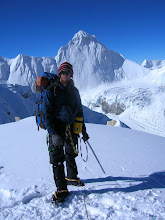
Photos 1 and 2 - Assisting with Mike's rescue high on the upper slopes of Everest - 28,000'. Notice the ever intensifying snow storm in the background.
As the afternoon slowly turned to early evening, the sun began to set. The splendor of the sun setting on the far horizon was a beuatiful sight to behold. All of this surrounding beauty seemed to hold no significance to my still missing teammates. Phil, Mike and a few Sherpas had not returned and I was mentally preparing myself for the worst. I figured that in his physical and mental condition, Mike was forever lost to the frozen slopes that steeply stretched above me. After all, when I last saw him he was incoherent and very combative. After the Herculean effort all the rescuers were giving, no one would have faulted them for just leaving Mike and saving their own lives. They had tried their best. One of the foundational principles of search and rescue is that the needs of the many out weigh the needs of the few. In this case there were now more than 10 people assisting with the rescue and with the weather turning from bad to worse, death's knock was getting louder. Any death would be tragic, but it would be silly to lose 11 or more people when all but 1 could have made it down.
More than an hour passed, the sky grew dark and there it was. The recognizable sound of climbing hardware jingling around on the harnasses of a group of people coming back in to camp. It was the rest of my team - including Mike! As he was being lowered down the mountain coupled with the shot of dexamethasone he began to regain coherency. By no means was he his regular self but he was upright and stumbling along. I greeted my teammates and told Mike that there were other ways of getting attention if he wanted it. Of course I was just continuing the friendly rapport Mike and I had developed over the previous 2 months. He blankly looked at me and just said "sure". I could tell he was still dealing with the delirium induced by his cerebral edema. Everyone was back safely, however, the most important night of Mike's life was drawing near. For someone in his condition and breathing supplemental oxygen at a high flow rate, the first night is the most critical. We had just a few medical supplies to sustain him through the night but it was obvious Mike would need a lot more attention. If only he would make it through the night.
Monday, August 16, 2010
The Summit Push (part 8)
A swift, deliberate punch to the face by our sirdar, Dorjee Sherpa was enough to bring Mike to some sort of coherency. He was really quite dazed and confused but after this lucky strike he began to cooperate. He still refused oxygen but there was no way he could refuse a shot to the left butt cheek of dexamethasone. This wonder drug helps to temporarily reduce cranial swelling therefore allowing the would be rescuers to have some sort of chance at bringing a climber down - alive. At this point several famous faces in the high altitude climbing world began to show up. Of course they quickly wanted to assist. I had no problem with that and we all welcomed as much help as possible. Eventually there were many people much stronger than I on the scene and so I decided to get myself down to camp IV and leave the rescue for the more able bodied souls.
The weather was a complete whiteout but thankfully the wind had died down and was not a problem. I rappeled a couple of the rock steps and made sure to stay tied in to the safety rope. I was exhausted. What an ordeal. I knew I was o.k. to get down. I just did not know how long it would take me. I could only muster up no more than 10 steps and I would have to sit down and rest. Oh well. Not a problem. I knew that eventually I would get down. Upon arriving at the balcony I noticed 2 of my teammates. One was a very accomplished marathon runner and she had some wonderful sports drinks tucked away inside her down suit. Upon seeing this I asked if I could have some and she gave me the entire bottle. The flavor of something other than bland, smokey tasting water was a treat. I drank almost the entire bottle and I noticed someone next to me crying. It was Dorjee, our Sirdar. He was in great shock because of the condition of Mike and he kept repeating that Mike was going to die. As a veteran of 6 previous expeditions to Everest, Dorjee had never lost a climber and he was devastated that Mike may be the first. I gave him some sports drink and reassured him that Mike was in capable hands and would almost certainly get down alive.
With that forced bit of calming reassurance I resumed my descent of the Triangular Face of upper Everest. I still was running low on energy and every 10 steps I would sit down and rest. This terrain looked really different than on the way up. Even though it was a whiteout I could still make out a few rock features that I could not have seen earlier due to the pre-dawn darkness. I knew I would be passing a few famous dead bodies on the descent and I kept my eyes wide open. I could now see camp IV down below and I knew I was getting close. I sat down again and took a few pictures of Lhotse and a few other mountain features as the clouds and snow were moving in and out. Eventually I got to the flat part of the South Col where, in a whiteout like this one, a dozen climbers got disoriented and most of them lost their lives on May 10, 1996. This time was different. In anticipation of bad weather a 5mm perlon cord was tied from the outermost tents of camp IV to the edge of the flat area. This way a climber could use this safety tether as a lifeline, almost assuring a safe arrival back at camp. I slowly wandered in to camp and was greeted by a few of our superstar sherpas. A hug, handshake and a warm drink were all welcomed enthusiastically. I took off my oxygen bottle and climbed in to the tent. After opening my sleeping bag I strapped on my oxygen and just layed there trying to understand what I had just accomplished. I was so excited for tomorrow when I was to be able to make the phone call home and let everyone who was diligently praying for me what had just happened. As excited as I was for what I had accomplished a Bible verse kept coming to mind. King David's words in Psalm 115 verse 1. "Not unto us (me), O Lord, not unto us (me), But to Your name give glory, Because of Your mercy, Because of Your truth." I still understood that only through the strength given to me by God, only through the mental toughness granted me that day by the Almighty was I able to do what I had just done. Several hours had passed and a few of my other teammates began to filter back in to high camp. Eventually, as darkness began to overcome us, all had returned except for two - Mike and Phil. I knew the rescue would take a little bit longer than normal because of the conditions. I just did not realize it would be this long. I prayed for their safety and dozed in and out of a joyous, hypoxic stupor.
The weather was a complete whiteout but thankfully the wind had died down and was not a problem. I rappeled a couple of the rock steps and made sure to stay tied in to the safety rope. I was exhausted. What an ordeal. I knew I was o.k. to get down. I just did not know how long it would take me. I could only muster up no more than 10 steps and I would have to sit down and rest. Oh well. Not a problem. I knew that eventually I would get down. Upon arriving at the balcony I noticed 2 of my teammates. One was a very accomplished marathon runner and she had some wonderful sports drinks tucked away inside her down suit. Upon seeing this I asked if I could have some and she gave me the entire bottle. The flavor of something other than bland, smokey tasting water was a treat. I drank almost the entire bottle and I noticed someone next to me crying. It was Dorjee, our Sirdar. He was in great shock because of the condition of Mike and he kept repeating that Mike was going to die. As a veteran of 6 previous expeditions to Everest, Dorjee had never lost a climber and he was devastated that Mike may be the first. I gave him some sports drink and reassured him that Mike was in capable hands and would almost certainly get down alive.
With that forced bit of calming reassurance I resumed my descent of the Triangular Face of upper Everest. I still was running low on energy and every 10 steps I would sit down and rest. This terrain looked really different than on the way up. Even though it was a whiteout I could still make out a few rock features that I could not have seen earlier due to the pre-dawn darkness. I knew I would be passing a few famous dead bodies on the descent and I kept my eyes wide open. I could now see camp IV down below and I knew I was getting close. I sat down again and took a few pictures of Lhotse and a few other mountain features as the clouds and snow were moving in and out. Eventually I got to the flat part of the South Col where, in a whiteout like this one, a dozen climbers got disoriented and most of them lost their lives on May 10, 1996. This time was different. In anticipation of bad weather a 5mm perlon cord was tied from the outermost tents of camp IV to the edge of the flat area. This way a climber could use this safety tether as a lifeline, almost assuring a safe arrival back at camp. I slowly wandered in to camp and was greeted by a few of our superstar sherpas. A hug, handshake and a warm drink were all welcomed enthusiastically. I took off my oxygen bottle and climbed in to the tent. After opening my sleeping bag I strapped on my oxygen and just layed there trying to understand what I had just accomplished. I was so excited for tomorrow when I was to be able to make the phone call home and let everyone who was diligently praying for me what had just happened. As excited as I was for what I had accomplished a Bible verse kept coming to mind. King David's words in Psalm 115 verse 1. "Not unto us (me), O Lord, not unto us (me), But to Your name give glory, Because of Your mercy, Because of Your truth." I still understood that only through the strength given to me by God, only through the mental toughness granted me that day by the Almighty was I able to do what I had just done. Several hours had passed and a few of my other teammates began to filter back in to high camp. Eventually, as darkness began to overcome us, all had returned except for two - Mike and Phil. I knew the rescue would take a little bit longer than normal because of the conditions. I just did not realize it would be this long. I prayed for their safety and dozed in and out of a joyous, hypoxic stupor.
Wednesday, July 28, 2010
The Summit Push (part 7)

Technically, I did have two options - descend or forever become a frozen bump high on the slopes of Everest. However, I really only had one choice. I had just stood on the very top of the world and I dearly missed my family at home. I wanted to quickly be reunited so therefore, I strapped my oxygen mask on, turned the flow rate to 1 1/2 liters per minute and started down. "Wow!" I said to myself. Going downhill is supposed to be easier but this was tough. I took a step and snagged my cramp-on on my down suit. I stumbled slightly, thankful I was safely tethered to the safety rope. I rehearsed in my mind the sequence of events that would lead me safely back to the South Col and the relative safety of my tent.
I worked my way down making sure to safely pass the climbers still on their way to the summit of Everest. At one very crucial passing, one with 8,000 feet of air beneath my feet, I got tangled up and lost my balance. Again, the rope anchored to the icy slopes held. "That was close" I yelled behind my hissing oxygen mask which was efficiently supplying life saving vapors to my lungs. I actually felt strong despite my seemingly lack of mobility. "Getting down is mandatory" I reminded myself. With that little bit of reassurance I quickly descended to the top of the Hillary Step. Luckily there were not many climbers ascending this steep portion of rock and ice so I worked my way to the rappel line. While rappeling I noticed one of my team members still on his way to the top. I checked to see how he was feeling and to ensure that he still had ample strength to get to the top and back down. We patted each other on the back, he offered his congratulations on my successful summit, and he reassured me that he was doing just fine. I made a mental note that I had now seen every one of my team members except for two. I easily could have missed them especially since everyone is thoroughly covered by a lofty goose down suit. I clipped back in to the traverse rope and made my way to the bottom of the South Summit. As painful as it was I now had to reascend 20 meters to the top and resume my descent on the other side. Upon reaching the top I noticed another teammate. She was huddled over, exhausted and running out of oxygen. At her pace she did not have enough oxygen to get to the top and back down safely. Therefore, she heroically decided to turn herself around, content with reaching the second highest point on earth.
So that was one more teammate. I had now past all of my teammates except for one. He was usually so strong. He was always near the front of the climbing group. I told myself that I must have passed him and in my hypoxic state did not realize it.
At the South Summit we picked up our empty oxygen bottles that we had exchanged for a full one on the ascent. Slowly I made my way down the Southeast ridge into a quickly building snow squall. I had hoped this would not be a repeat of the disaster on Everest in 1996 when 11 climbers got lost on the descent in a snowstorm similar to the one growing around me. Most of those climbers are still on Everest, frozen in the spot where they eventually collapsed, lost and hopelessly beyond extreme fatigue.
There are a series of rock steps which must be navigated in order to continue down. I threaded the rope through my rappel device and began one of the many rappels that would eventually lead me to my tent 2,000 below. In what seemed to be just a couple of minutes I came upon another bottleneck at the top of another series of fixed lines. Nearing the front of the queue I noticed two things strangely out of place. One was the odd sight of only seeing the head of one climber because his body was hidden by the sheer dropoff on either side and the other was a huddled mass of yellow collapsed on the ice. It turns out the head I saw was one of my teammates and he quickly recognized me. He removed his oxygen masked and yelled "Mikey's dying, Mikey's dying!" Collapsed on the snow in front of me was one of my teammates. The last of whom I was certain I had recently passed and just did not recognize on the ascent. However, I never did pass him. He never made the summit. As it turns out he was suffering from delusional swelling of the brain and was mumbling incoherently. Without the strength to move he had just sat down refusing to go anywhere. I could only see the head of my other teammate because Mikey was not tied in to the safety rope and he was selflessly being held on to the mountain by a teammate who refused to continue his own descent in order to save the life of another. By this point the snow squall had turned in to a full scale blizzard. I was tired but new what I had to do. There was no way I could leave Mike to die up there. I had to help him down, but first, we had to get him moving and he demonstrated very little effort in attempting to get down. His delusional thoughts had given him permission to just sit there and die and he reassured us that that was exactly what was happening.
Wednesday, July 14, 2010
The Summit Push (part 6)
It was really quite easy to make the decision to carry on. After all, this was the moment I had worked and trained for for so long. However, the life sustaining supplemental oxygen I was breathing was a precious commodity at this elevation and I did not want to run out. Although, I had trained very hard for several years just to get to this place and I was confident in my strength - both physical and metal. With that rational my decision was made. I kept the flow rate at 1 liter per minute and I continued on toward the summit.
Upon reaching the balcony the route meanders sharply up and to the left or slighly northwest. With the aid of my headlamp I was looking around trying to memorize various parts of the route. Upon my descent, should that be in a whiteout or blizzard, I would need all the help I could get to return to camp safely. Even in the dark the ridge was very clearly defined. A sharp drop-off on either side would certainly lead to an express ride back to the bottom of the mountain. I was now entirely on the upper southeast ridge of Mount Everest. I was so happy just to be there. I got to climb at my pace for around an hour or so and there it was - another traffic jam. Here the route turns completely vertical for a small series of rock steps. One rope and a plethora of people who were, at this point, clearly fatigued. I did not look at my watch but upon reaching the top of these steps I knew it had been more than an hour. At this point the eastern horizon was turning a beautiful pink and purple and then quickly I saw bursts of orange, yellow, and red. Watching the sunrise from this lofty perch was truly an honor and a privilege not had by many.The climbing route continued steeply upward and I just kept taking one step at a time. I would also play little mind games with my self. When was my birthdate? When was my wedding anniversary? When was Alexander born? I would then purposely wiggle my fingers and toes. All of this in an attempt to ensure proper mental clarity and focus as well as warding off frostbite from the extreme cold. Eventually I attained the South Summit of Mount Everest. At 28,800' I was now standing on the 2nd highest point in the entire world. Even better was the beautiful view across the knife edge traverse and the famous Hillary Step. The most famous vertical pitch of rock and ice in all of mountaineering. This was the point where I would change out my oxygen bottle for a brand new, completely full one.
After that essential gear adjustment I began the agonizing descent back onto the ridge and made my way toward the Hillary Step. I had worked hard for every foot of elevation gain and I did not want to lose any by descending. However, to begin the traverse I first had to go down. I quickly made it to the Hillary Step and after a short wait it was finally my turn. Climbing this completely vertical pitch of rock and ice at just a shade under 29,000' was exhausting. Not to worry I told myself. Be patient.
Topping out on this famous feature I bagan to feel that just maybe I would stand on top. I did not want to feel overconfident because I knew that could lead to a fatal error but I knew I was close. Another half an hour of scrambling, jumping, climbing, and perseverance I came to a huge rock. I had to gingerly slide around this rock and hopefully not fall. The amount of air under my feet made even me a little uneasy. I confidently climbed around this rock and there it was. I could see in the close distance a group of people huddled around a bunch of prayer flags. There was a clearly defined hump of snow and nothing but a deep blue sky behind it. It was at this point that I knew I would make it. Five minutes later I took my remaining steps upward to the rooftop of the world."Woooooohoooooo! I did it!" Oh what a feeling of accomplishment. The thrill and experience was all I had dreamed it would be. The time was 8:15 a.m. on May 23, 2010. Eleven and one half hours after starting out for the summit, I stood on top.
I completely took off my oxygen mask and I just looked around. I needed to find somebody to take my picture - and a lot of them! Many pictures and video were taken on the summit and perhaps 20 - 30 minutes had passed. At this point the wind was picking up and the once crystal clear blue sky was filling with clouds. The famous snow plume of Everest was beginning to show and blow off toward Tibet. It was time for me to get down - quickly and safely. I recalled the words of Ed Viesturs, North America's most accomplished high altitude mountaineer. "Going up is optional, getting down is mandatory." In the midst of my joy and celebration I did not realize the amount of time I spent on top of Everest without my oxygen mask on. I did not want to risk dizziness and stumble 10,000' striaght in to Tibet so I quickly put the mask back on and took in a few deep breaths. "Getting down is mandatory" I told myself. "I have to do this." Easier said than done. This is the portion of the climb where most fatalities occur - the descent. Climbers use every bit of their strength to stand on top and leave nothing in reserve to get down. I turned around, tied into the rope and began my descent. At this point I realized my error in judgment in taking off my oxygen mask on top. Fatigue quickly set in and all I wanted to do was sit down and not move. I wanted to rest but I did not want to die, which almost always happens when a climber loses their will to descend. Which option did I want more?
Video Credit: Raphael Gernez
Sunday, July 4, 2010
The Summit Push (part 5)

Photo 1 - The view from the South Summit - 28,850'. In the distance is the famous Hillary Step, the bare, vertical patch of rock. Notice the steep drop offs on each side. The left side is a 10,000 foot drop in to Nepal while the right side is an 8,000 foot drop in to Tibet.
Photo 2 - A closer view of the Hillary Step.
Wrapped up in every piece of clothing I had, in addition to a -40F sleeping bag I was feeling quite content. Here I was stretched out in my tent at 26,000' listening to the sound of the wind blow. If the wind did not abate there would be no attempt to summit. However, I remained quite optimistic. I had read about this very situation many times from the various successful summiteers over the years. Every time they would recall how the wind just stopped and their summit push began.
As a group we decided to stagger our departure from the South Col. A few of the slower members would leave at 8:00pm and the faster members would leave at 9:00pm. The idea was that the faster members would eventually catch up to the others some where above the Hillary Step and we would all summit together. It seemed to be a well thought out plan.
And then it happened. Just like I had read so many times from other climbers, the wind just stopped. Of course there was a stray breeze here and there but nothing like we had just endured. This was it! It was a go! It was 7:00 p.m. and climbers from other groups began leaving for the summit. We had to hurry. This was not the time nor the place to get stuck behind a bunch of amateur climbers as they re-learn proper rope technique. But, moving fast at this altitude is something reserved for the over ambitious dreamer. The air is so thin that just sitting up will leave a climber out of breath. Earlier in the evening I had melted enough ice to afford me one liter of water. That was it. All I would be able to drink for the next 12 - 16 hours. I then took off my oxygen mask so that I could move about a little easier. I had so many minor things to do. Pack my extra oxygen bottle, re-distribute the contents of my pack, try and eat a snack, and more. Soon it was 8:30 p.m. and I popped my head out of the tent. The night sky was amazing. The stars were so bright. There seemed to be many billions just twinkling away. I was in awe. The best view was reserved for only the select few on Earth who were gazing upon creation from this vantage point. On the far away horizon, where the last of the sun's rays were slowly disappearing, I could just barely see it. The curvature of the Earth. How amazing! I knew that, if given the opportunity, the views would only get better.

I quickly caught up to the climbers who had left 15 minutes prior to me and the traffic jam started all over again. We inched our way up ever so slowly. Despite the frustration I remained optimistic. The weather was perfect. Twenty degrees below zero, no wind, and nothing but stars in the sky. I was doing it! The many years of dreaming and reading were all coming down to these next few hours. Could I do it? I did not know but I was going to give it my best shot. The triangular face is very steep. As steep as the Lhotse Face and in spots steeper. This year was a lean snow year on Everest so there was more rock than normal. This fact was realized when we all reached a series of 20' vertical rock steps. There was only one way up and only one rope. These features caused the progression toward the summit to come to a stand still. I did not want to look at my watch but I knew that gaining the balcony in 4 hours was becoming more of a fantasy than a reality. I kept reassuring myself that I could do it. What could I do? I did not want to climb unroped and yet I might have to if I wanted to make the summit and not run out of oxygen. I then considered turning down my flow rate of oxygen. I felt strong and I knew I could do it. After all, we were climbing very slowly. At one of the many stand still moments I took off my pack and oxygen and turned my flow rate down to 1 liter per minute. This is far less than what most climbers climb on but it increased my availability of oxygen by more than 16 hours. At this rate I now had almost 30 hours of oxygen left between my 2 bottles. That reassurance did not make the line upward move any faster. In fact, we were stopping more frequently. I was getting more and more frustrated. All I had to do was get to the balcony and I could begin to pass. After what felt like an eternity I reached the balcony. It was still pitch black and just a light breeze was blowing. This is the spot where many people stop and rest, change oxygen bottles and then continue on to the summit. I knew I could not stop and rest. I had to begin passing people, but first I decided to look at my watch to see just how long it took me to get here. I was hoping for 4 hours and was somewhat shocked to find out it had been just over 6 hours. This was not good. I was now coming to the most physically demanding portion of the summit attempt and I was craving more oxygen. I was left not knowing what to do. Should I turn up my flow rate of oxygen and risk not summiting because I ran out or should I keep the flow rate at 1 liter per minute and risk not having the strength to continue? I wrestled back and forth in my mind for a few seconds before I could come to any conclusion. At that point I made my decision. I knew what I had to do. Would it work?
Subscribe to:
Posts (Atom)